
EQ9 and Australian Online Casino Rules: What the Law Says
 Available in AU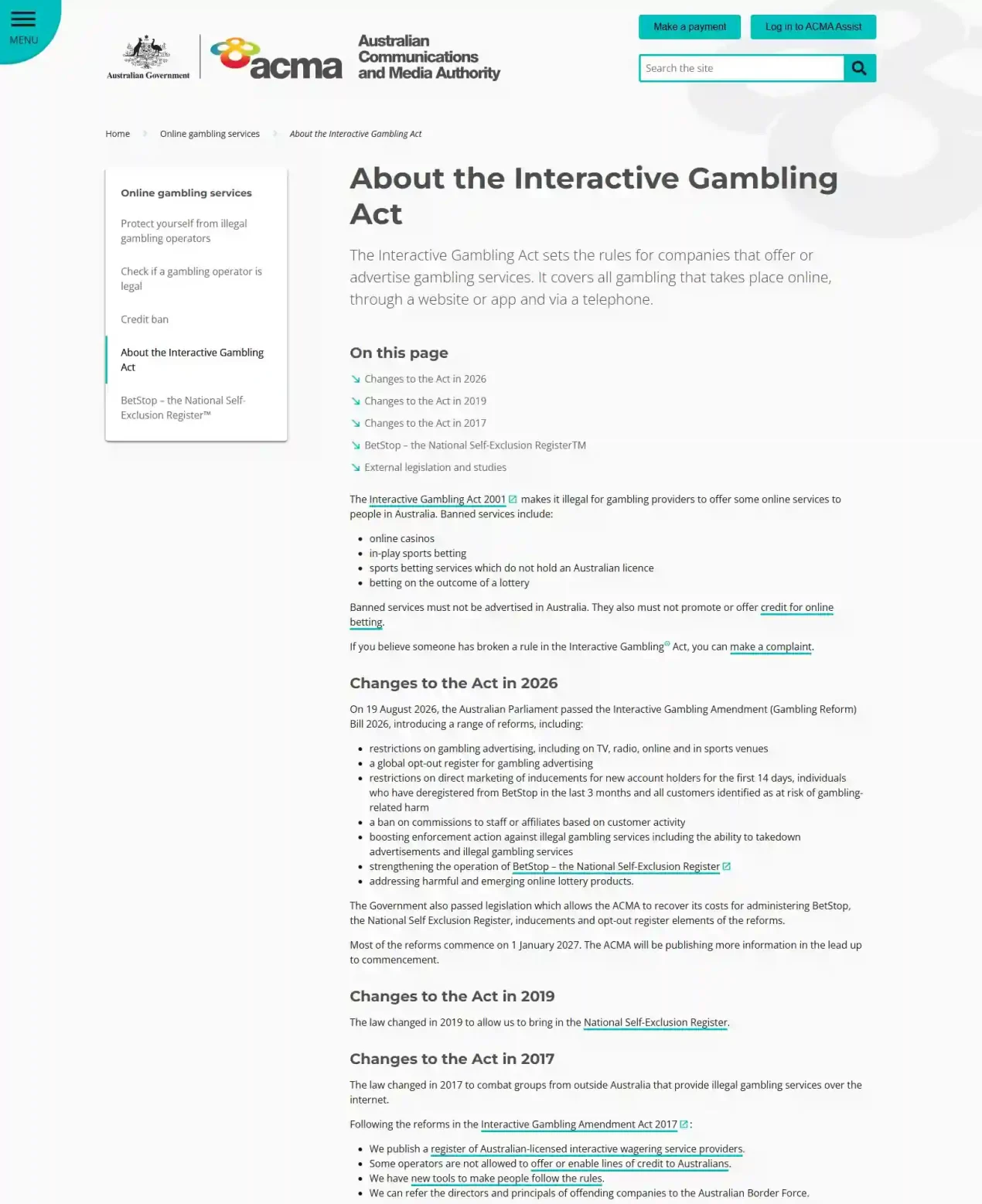
Contents
Australian federal law draws an important distinction between online casino services and licensed wagering. The Australian Communications and Media Authority says the Interactive Gambling Act 2001 makes it illegal for gambling providers to offer certain online services to people in Australia, and its list of banned services includes online casinos. Licensed online and phone wagering is a different category with its own register and consumer-protection framework.
For EQ9, the current ACMA register check matters because no Australian local licence was verified for the brand on 17 September 2026. That does not mean every form of online gambling is banned, and it should not be rewritten as a claim that an individual player commits a crime simply by visiting or using EQ9. The legal framework described here is primarily about what providers may offer or advertise to people in Australia. This is an informational summary, not legal advice.
The central rule: online casino supply is prohibited
The main federal law is the Interactive Gambling Act 2001. ACMA’s current guidance says it is illegal for gambling providers to offer some online services to people in Australia. The banned-services list specifically includes online casinos, along with in-play sports betting, sports betting services that do not hold an Australian licence, and betting on the outcome of a lottery. The law also restricts advertising of banned services. For the broader context, see the EQ9 review.
That wording is provider-focused. It regulates the supply and advertising of interactive gambling services to people in Australia. This distinction is important because casual summaries often collapse the framework into “all online gambling is illegal in Australia”, which is not accurate. Australian-licensed online and telephone wagering services exist in a separate regulated category. ACMA publishes a register of licensed interactive gambling providers for that purpose.
When evaluating EQ9, the useful question is therefore not simply whether the website can be opened. The more relevant question is what category of gambling service it supplies, whether that category can lawfully be supplied to people in Australia, and whether the operator appears in the Australian register where a local wagering licence would be expected.
Online casino versus licensed wagering
| Category | Australian federal position | Practical check |
|---|---|---|
| Online casino games | ACMA identifies online casinos as prohibited interactive gambling services that providers must not offer to people in Australia | Do not treat site accessibility or AUD branding as proof of legality |
| In-play sports betting online | Listed by ACMA among banned services | Distinguish it from permitted forms of wagering |
| Licensed online and phone wagering | Operates under Australian licensing and federal safeguards | Check the ACMA register for provider and licensing authority |
| Unlicensed regulated wagering | Providers may not offer regulated wagering without the required Australian licence | Use the register rather than marketing claims |
This product-category approach prevents two common mistakes. The first is assuming that because sports wagering can be legally offered by licensed providers, the same is true of online casino games. The second is assuming that because an offshore casino accepts Australian customers or Australian payment methods, it has an Australian licence. Neither follows from the legal framework.
Where EQ9 fits in the register check
ACMA’s “Check if a gambling operator is legal” page says that an online wagering service must be on the register of licensed interactive gambling providers to operate in Australia as a licensed wagering provider. The current register was checked for EQ9 on 17 September 2026, and EQ9 was not found. The narrow and supportable wording is that no Australian local licence was verified for EQ9.
That finding should not be extended to unrelated claims. It does not prove whether a particular game loads, whether live chat answers, or whether PayID appears in a cashier. Those are separate product and operational facts. Conversely, the presence of those features does not create an Australian licence. The EQ9 trust guide uses this separation as its evidence model.
ACMA also advises consumers to avoid services not on the licensed wagering register and warns that illegal gambling services are unlikely to provide the same important customer protections. That consumer-protection point is relevant when comparing dispute paths, self-exclusion coverage and regulator oversight.
How ACMA enforces the Interactive Gambling Act
ACMA can investigate providers and take enforcement or disruption action when services breach the Interactive Gambling Act. Its current enforcement materials describe formal warnings, investigations and website blocking among the tools used against prohibited or unlicensed services. Website blocking is carried out by requesting Australian internet service providers to block access to identified sites under telecommunications powers.
The scale of that enforcement is not theoretical. ACMA reported in July 2026 that 1,774 illegal gambling and affiliate websites had been blocked since its first blocking request in November 2019, and that more than 230 illegal services had withdrawn from the Australian market since enforcement changes introduced in 2017. Those figures describe ACMA’s overall enforcement program, not a finding about EQ9 specifically.
A site being reachable today is therefore not equivalent to a regulatory approval. Enforcement is investigation-based and changes over time. A domain may remain reachable until action is taken, may change domains, or may be blocked later. For a reader, current register status and ACMA’s published enforcement information are more meaningful than simple accessibility.
Advertising rules also matter
The Interactive Gambling Act framework does not stop at the underlying service. ACMA states that banned interactive gambling services must not be advertised in Australia. This matters because a casino can appear in search results, social posts, referral material or promotional pages even when its service category is prohibited from being supplied to people in Australia.
Readers should therefore avoid treating the visibility of Australian-targeted advertising as evidence that an operator has been approved by an Australian regulator. Marketing reach, local spelling, AUD references and familiar payment methods can all make a service look locally established, but the regulatory test is separate.
The same separation applies to bonuses. A welcome offer may have its own eligibility rules, and those rules can change. Bonus availability does not answer whether the underlying casino service may lawfully be supplied in Australia. If you are reviewing EQ9’s promotions, use the site’s current terms and the dedicated bonuses page rather than using a promotion as a proxy for regulatory status.
The 2026 reforms: passed, but most start in 2027
On 19 August 2026, the Australian Parliament passed the Interactive Gambling Amendment (Gambling Reform) Bill 2026. ACMA’s updated guidance lists reforms covering gambling advertising, a global advertising opt-out register, restrictions on direct marketing of inducements to certain people, a ban on activity-based commissions for staff or affiliates, stronger enforcement tools, changes to BetStop and measures aimed at emerging online lottery products.
The timing is critical. ACMA says most of the listed reforms commence on 1 January 2027. As of 17 September 2026, they should be described as passed reforms with a scheduled future commencement, not as measures that are already fully in force. That date distinction is especially important in a fast-changing regulatory area where summaries can quickly become stale.
The 2026 package does not change the basic need to distinguish prohibited online casino supply from licensed wagering. It adds and strengthens measures around advertising, enforcement and consumer safeguards. Readers checking these rules after 1 January 2027 should recheck ACMA guidance because implementation details may have been updated.
What BetStop covers, and what it does not
BetStop is Australia’s National Self-Exclusion Register for Australian licensed online and phone wagering services. A person can use it to exclude themselves from those licensed wagering services through one national process. This is an important consumer-protection mechanism, but it should not be assumed to cover every offshore or prohibited online casino website.
That difference matters when assessing an operator that is not verified in the Australian licensed wagering register. A reader should not assume that the account controls, regulator complaint path or self-exclusion coverage available in the licensed wagering system automatically extend to that operator. Where responsible-gambling controls matter to you, check what the specific site provides and understand the difference between site-level tools and Australian statutory mechanisms.
What the rules mean for an EQ9 user considering payments
Regulatory status and payment functionality answer different questions. A payment method can technically work even when the underlying service is not an Australian-licensed online casino. EQ9 has Australian-facing payment content, but that should not be treated as licensing evidence. The payments focuses on method availability and account-level checks rather than implying regulatory approval.
Before depositing, verify the current cashier instructions and understand how withdrawals are handled. Avoid sending funds to bank details copied from an old saved image or review. If a promotion is involved, save the terms that apply to that offer. If verification is required, use the current account interface and support channels identified by the site. The account guide covers those operational checks separately from legal status.
This separation is useful because a regulatory concern should not force invented claims about payment performance, while a functioning payment route should not be allowed to blur the legal framework. Each finding should rest on the evidence relevant to it.
Does Australian law make the player a criminal for accessing EQ9?
Current evidence does not make that claim. The ACMA material used here describes provider obligations and prohibited services, including the rule against providers offering online casino services to people in Australia. It also explains enforcement against providers and websites. That is different from asserting that an individual player commits a criminal offence merely by visiting or using an offshore casino.
If you need advice about your own legal position, a dispute or a specific transaction, use a qualified Australian legal adviser. The regulator’s public framework is summarised here without interpreting personal liability beyond what the cited regulatory guidance supports.
A practical reading of the framework
- Do not use availability as proof of legality. A site can be reachable without being Australian licensed.
- Do not use AUD or PayID as proof of licensing. Localised payments are an operational feature.
- Check ACMA’s register for wagering licences. EQ9 was not found in the register checked on 17 September 2026.
- Keep product categories separate. Online casino services and licensed wagering are treated differently.
- Read reform dates carefully. The 2026 package passed on 19 August 2026, while most listed measures are scheduled for 1 January 2027.
- Recheck current regulator guidance. Enforcement lists, blocked sites and implementation details can change.
How the Australian framework applies to EQ9
The Australian framework is specific enough to support a careful finding. Online casino services are among the prohibited interactive gambling services that providers must not offer to people in Australia. Licensed wagering is a separate category, and ACMA maintains a register for those providers. EQ9 was not found in that register during the current check, so EQ9 is not described as Australian licensed.
That regulatory finding should stay distinct from product observations. It is possible to discuss EQ9’s games, support, mobile access or payments using evidence for those features while still stating the Australian legal context accurately. Keeping those layers separate is the best way to avoid both understating the regulatory issue and overstating what the evidence proves about an individual user’s experience.
FAQ
Are all forms of online gambling illegal in Australia?
No. ACMA distinguishes prohibited interactive gambling services such as online casinos from Australian-licensed online and phone wagering services.
Is EQ9 licensed by an Australian authority?
No Australian local licence was verified for EQ9 in the ACMA register checked on 17 September 2026.
Can ACMA block gambling websites?
Yes. ACMA uses website blocking as one of its enforcement and disruption tools for illegal online gambling services.
Are the August 2026 gambling reforms already fully in force?
No. ACMA says most of the reforms passed on 19 August 2026 are scheduled to commence on 1 January 2027.
This material was created by the EQ9 Australia Guide team.
Related posts
EQ9 Withdrawals: Methods, Verification and Cashout Checks
Using PayID at EQ9: Australian Deposit Guide and Checks