Is EQ9 Legit? Licensing, Reputation and Trust Checks for Australia
 Available in AU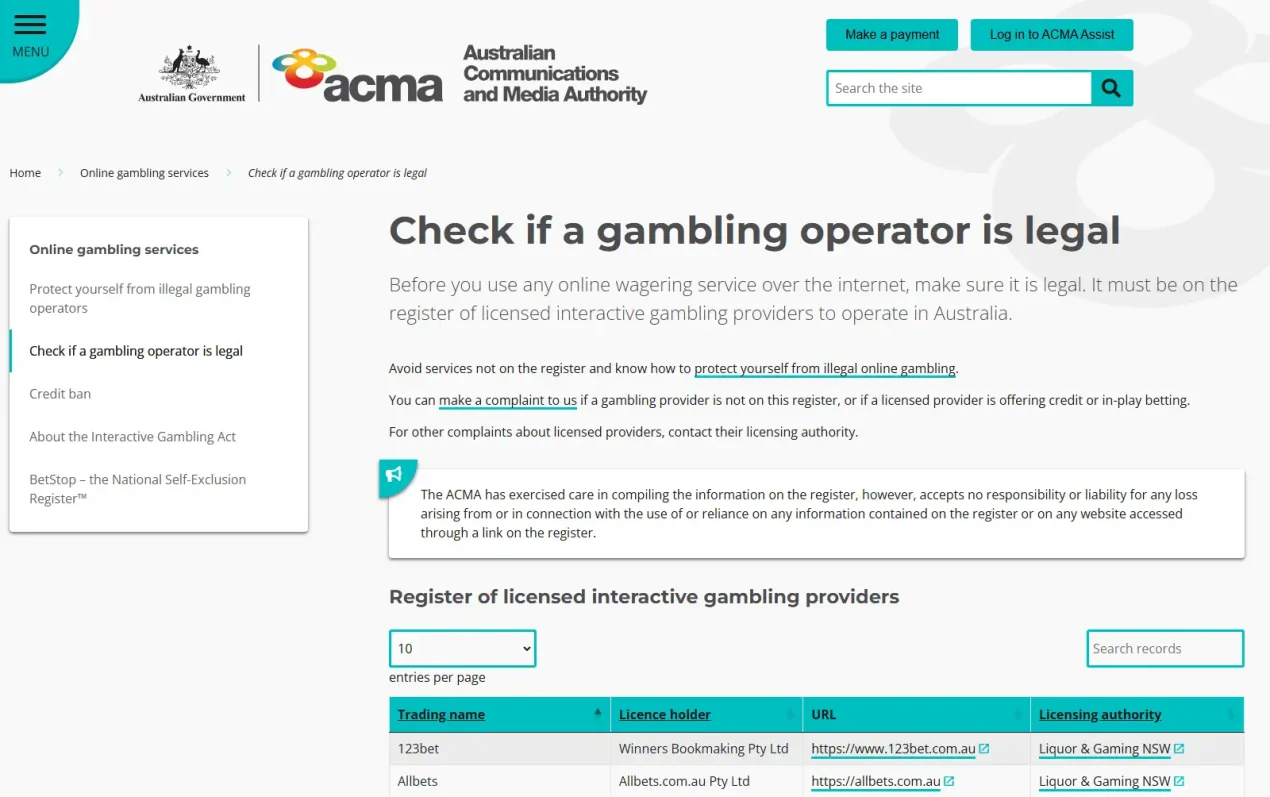
Contents
EQ9 should be assessed through separate evidence layers rather than a single “safe” or “scam” label. For an Australian reader, the clearest regulatory fact is that no Australian local licence was verified for EQ9 in the Australian Communications and Media Authority register checked on 17 September 2026. That matters because the register is the official reference point for licensed interactive wagering providers in Australia. It does not, however, automatically prove or disprove every separate claim about EQ9’s games, support, payments or day-to-day operation.
A second licensing point also needs care. EQ9-branded material has made a PAGCOR accreditation claim, but that claim was not corroborated in the available licensing evidence, so current evidence does not present PAGCOR accreditation as verified. The more useful approach is to separate verified regulatory evidence from product features, then test the latter on their own evidence. Current evidence shows how to do that before creating an account or depositing.
How to check EQ9 trust claims
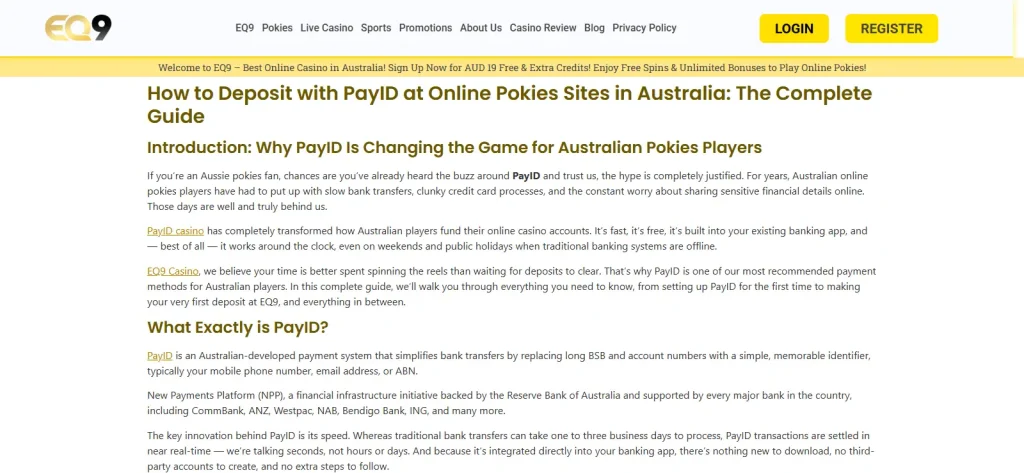
Trust questions become clearer when evidence is ranked by what it can actually prove. A regulator register can establish whether a named provider appears as locally licensed. It cannot tell you whether a site’s lobby is easy to navigate or whether support answers quickly. A brand-controlled page can show what the operator currently says about its service, but it is weaker evidence for an independent licensing finding. A customer-review platform can reveal recurring complaints and praise, but it is not an audit of balances, withdrawals or game fairness. For the broader context, see the EQ9 review.
For EQ9, use the following order of checks. First, verify Australian regulatory status directly with ACMA. Second, check whether the operator clearly identifies who runs the service and which licence or legal entity it relies on. Third, compare payment and support claims against current service pages and your own account screens. Fourth, use independent reviews only as a qualitative warning system for recurring themes. Finally, keep copies of terms that apply when you deposit or claim a promotion.
| Evidence type | What it can establish | What it cannot establish alone |
|---|---|---|
| ACMA register | Whether a provider is listed as Australian licensed interactive wagering | Quality of an offshore casino’s support, games or cashier |
| Operator terms and account pages | Current published procedures, eligibility wording and service features | Independent confirmation that every claim is accurate in practice |
| Payment screens | Methods actually presented to your account at that moment | Future availability, bank handling time or universal fees |
| Customer reviews | Examples of reported user experiences and recurring complaint themes | A statistically reliable payout rate or a definitive legitimacy assessment |
Australian licence status
The ACMA page for checking whether a gambling operator is legal says an online wagering service must be on the register of licensed interactive gambling providers to operate in Australia as a licensed wagering provider. EQ9 was not found in that current register during the 17 September 2026 check. The supported finding is narrow: no Australian local licence was verified for EQ9. It would be inaccurate to upgrade that into an Australian-licensed status based on review sites, marketing language or the presence of Australian-facing payment options.
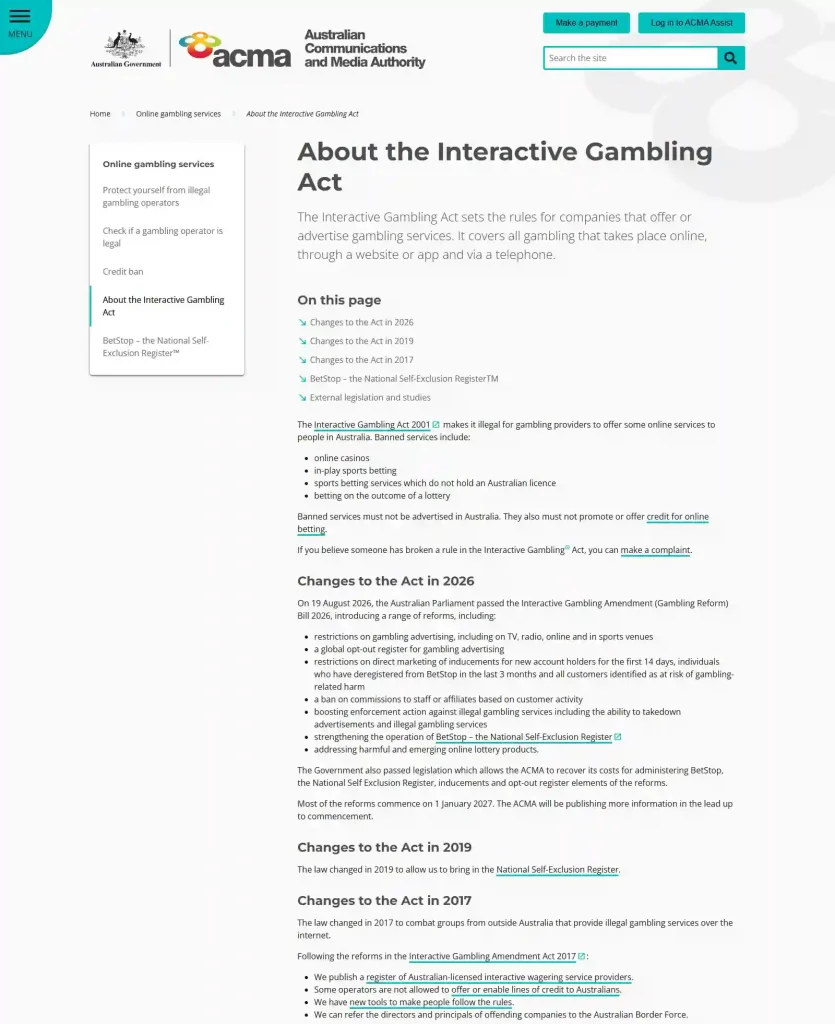
This distinction is especially important because Australian law treats product categories differently. The federal Interactive Gambling Act framework prohibits providers from offering online casino services to people in Australia, while licensed wagering services occupy a separate regulated category. The Australian online casino rules explains that framework in more detail. For trust analysis, the immediate point is that a reader should not confuse a site’s availability, Australian branding or AUD support with an Australian licence.
The unresolved PAGCOR claim
Some EQ9-branded material has referred to PAGCOR accreditation. That claim was not corroborated by the available licensing sources, so it is not treated here as a verified licence. This is exactly the kind of statement that deserves stronger proof than a logo, footer badge or promotional sentence. A licensing claim should be traceable to a regulator record, a licence number that can be independently checked, or a current regulator-hosted entry identifying the relevant legal entity.
If EQ9 later provides a licence number or named licensed company, the useful next step is not to accept the label at face value. Match the legal entity, trading name, domain and licence status against the regulator’s own records. If those elements do not line up, treat the claim as unresolved until they do. That process is more reliable than relying on the repetition of the same licensing phrase across affiliate reviews.
Support is a useful operational signal, not a licence substitute
EQ9 promotes 24/7 customer support, including live chat. That is relevant because a working support channel gives users a way to ask about account access, verification, deposits, withdrawals and promotion terms. It is still an operational feature, not regulatory proof. A responsive chat agent cannot replace a regulator entry, and a regulator entry would not by itself guarantee that every support interaction is satisfactory.
Use support proactively. Before depositing, ask a concrete question that matters to your account, such as which payment methods are currently available, whether verification is required before withdrawal, and where the current withdrawal conditions are displayed. Save the answer if it materially affects a decision. If the answer conflicts with the cashier or published terms, rely on the written account-level terms and ask for clarification before proceeding.
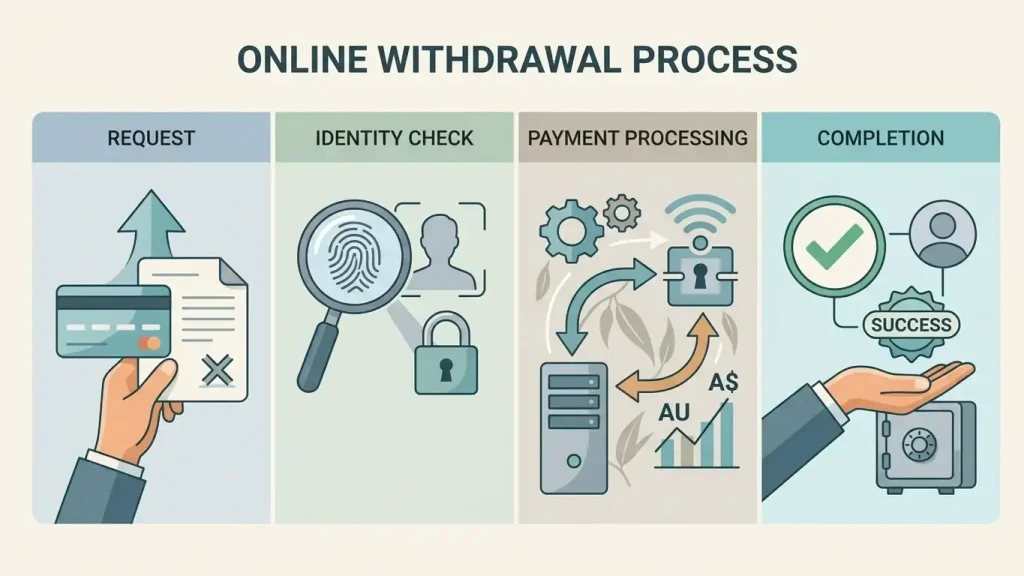
The account and verification explains the information worth checking at sign-up, while the withdrawal guide focuses on how to assess withdrawal steps without inventing processing times or limits that have not been directly confirmed.
Payments: verify the method, then verify the conditions
Payment availability can be evidence that a service has been configured for a particular customer journey, but it should not be mistaken for a legal approval. EQ9 has promoted PayID in its Australian-facing material, and the broader payment review covers that method and other cashier considerations. The more important trust question is whether the payment method shown to you is accompanied by clear deposit and withdrawal instructions, any relevant limits, and a consistent account identity.
Before transferring money, compare the destination details shown in the cashier with the instructions shown by the service. Do not reuse old banking details from a saved image, message or previous transaction unless the current cashier explicitly instructs you to do so. Payment destinations can change, and static details copied from third-party pages are a poor basis for a new transfer. See the payment guide for a method-by-method decision framework.
For withdrawals, the trust signal is not a promise such as “fast” on its own. More useful evidence includes whether the withdrawal route is visible, whether the account shows pending or completed status, whether verification requests are explained, and whether support can identify what action is actually required. Exact time limits, fees and document requirements should be taken from current first-party terms when available rather than guessed from old reviews.
How to read EQ9 customer reviews without over-trusting them
EQ9 has a current Trustpilot profile with both positive and negative posts. Recent negative reviews include complaints about promotions and withdrawal experiences, while EQ9 has posted replies asking reviewers to contact support or provide account details. Older positive reviews praise features such as PayID withdrawals, games and live chat. These examples are useful for identifying questions to investigate, but they do not provide a reliable statistical measure of payout performance or legitimacy.
There are several reasons to keep review evidence in proportion. Reviews are self-selected, so satisfied and dissatisfied users may be represented very differently. Platforms can remove, verify or challenge reviews, and the public cannot independently inspect the underlying account history. Brand responses can add context but remain the operator’s side of a dispute. Even a large number of similar comments does not replace primary evidence about licence status or the terms applying to a specific account.
A better use of reviews is diagnostic. If multiple users mention withdrawal verification, check the current verification process before depositing. If promotion disputes appear, save the offer terms before opting in. If support quality is repeatedly praised or criticised, test the live chat with a specific pre-deposit question. Reviews can tell you where to look more closely; they should not be converted into a universal assessment.
Transparency checks that matter before depositing
Good pre-deposit due diligence is mostly about reducing ambiguity. Start with identity. Look for a named operating entity, a physical jurisdiction and licence information that can be checked independently. If the site relies on a licence claim, the details should be specific enough to verify. Vague badges, generic “regulated” language or an unsupported accreditation reference deserve further checking.
Next, check the money path. Open the cashier rather than relying on an older review image. Confirm the methods actually available to your account and the currency displayed. Read the withdrawal section before making a deposit, because a payment method being available for deposits does not guarantee it will be the withdrawal route. If a bonus is involved, separate the cash balance from bonus conditions and save the exact terms that apply to that offer.
Then check account controls. Make sure you can find the rules for password recovery, identity verification and account closure. If verification is requested, upload documents only through a channel that the site’s current account or support interface identifies. Do not send identity documents to an address copied from an old forum post or third-party review.
Finally, consider what happens if something goes wrong. A locally licensed wagering service has an Australian licensing authority and falls within the Australian licensed wagering framework. Where no Australian local licence is verified, you should not assume the same local complaint path or consumer-protection structure applies. That difference deserves weight in a trust assessment even when individual product features appear to work normally.
Independent checklist for evaluating EQ9
- Check ACMA yourself. Search the current Australian register rather than relying on an older review image.
- Verify any claimed overseas licence. Match the operator name, domain and licence number with the relevant regulator’s own record.
- Open the current terms. Save the sections covering withdrawals, verification, promotions and account restrictions that matter to you.
- Test support before depositing. Ask one specific question and keep the written response if it affects your decision.
- Inspect the cashier in your account. Use current payment instructions, not copied or historical payment details.
- Treat reviews as anecdotes. Look for repeated themes to investigate rather than treating a star rating as proof.
- Keep transaction records. Save deposit confirmations, withdrawal requests and relevant chat references.
- Separate legal status from product operation. A working game or payment method is not evidence of an Australian licence.
EQ9 trust findings
The strongest verified trust finding for Australians is regulatory rather than promotional: EQ9 was not found in the current ACMA register, so no Australian local licence was verified. The PAGCOR accreditation claim found in EQ9-branded material also remains unverified in the available licensing evidence and should not be presented as established licensing. Those are material limitations in the licensing evidence.
Other operational observations need to stay separate. EQ9 promotes 24/7 live-chat support, Australian-facing payment content and casino products, and there are public user reviews describing both positive and negative experiences. Those points help explain how the service presents and operates, but none of them resolves the licensing question or proves payout reliability for an individual account.
For an Australian reader, the most defensible approach is evidence-by-evidence verification: check the register, verify any claimed licence at source, inspect current account terms, test support, and keep records of the conditions that apply to your deposit or promotion. That produces a more useful trust assessment than a binary label.
FAQ
Is EQ9 licensed in Australia?
No Australian local licence was verified for EQ9 in the ACMA register checked on 17 September 2026. That statement is about local licensing status, not every separate feature of the service.
Does EQ9 have a verified PAGCOR licence?
The available evidence does not treat PAGCOR accreditation as verified. EQ9-branded material has made that claim, but the licensing evidence used here did not corroborate it.
Can Trustpilot reviews prove EQ9 pays reliably?
No. Reviews can reveal individual experiences and recurring themes, but they are not an audit and cannot establish a statistically reliable payout rate.
What should I check first?
Start with the ACMA register and any claimed overseas licence, then read the current withdrawal, verification and promotion terms that would apply to your account.
This material was created by the EQ9 Australia Guide team.
Related posts
EQ9 and Australian Online Casino Rules: What the Law Says
EQ9 Withdrawals: Methods, Verification and Cashout Checks